The Death of the Report Grind: How Professionals Are Finally Automating Their Most Hated Task
For every professional who has spent an evening fixing a report they should never have had to touch.
---
You remember the night. Maybe it was a Tuesday. Maybe it was worse, a Sunday.
You had finished the real work hours ago. The analysis was done, the numbers checked, the conclusions written up. But there you were at 10 PM, adjusting header spacing in a Word document, re-pasting a table that had broken its own formatting for the third time, searching for the slide where someone had used a slightly different shade of blue. You were not doing your job anymore. You were doing something else entirely, the kind of tedious cleanup work that somehow always ends up following you home.
Every professional has a version of this memory. It sits somewhere between frustrating and embarrassing. Embarrassing because, deep down, you know this is not what you were hired to do.
---
The Time Nobody Talks About
No one lists "will spend 20% of their time reformatting documents" in a job description. But the numbers tell a different story.
Ask anyone in consulting, finance, or law how much time they spend formatting reports each week and the answers are remarkably consistent: somewhere between half a day and a full one. Not writing. Not thinking. Not advising. Just formatting. Here is what that looks like across different roles:
- Consultants report spending up to two days a week on slide decks and client reports, much of it spent on layout rather than the actual content.
- Finance analysts at banks and investment firms lose an estimated five to eight hours a week assembling reports: pulling numbers from spreadsheets, filling in templates, and making sure everything looks right before Monday's meeting.
- Lawyers and paralegals spend a significant chunk of time formatting memos and client reports, work that rarely appears on an invoice.
Add those hours up across a team. Multiply by a year. The result is not just an inconvenience. It is a serious drain on the time that actually matters.
And yet, for decades, everyone just accepted it. The problem was invisible because it was so common.
---
What Automation Actually Looks Like
When people talk about AI in the workplace, it often sounds very big and abstract. Words like "disruption" and "transformation" get thrown around, none of which help you with the table of contents you spent an hour fighting last Tuesday.
So here is what report automation actually looks like, using a tool like Associum.
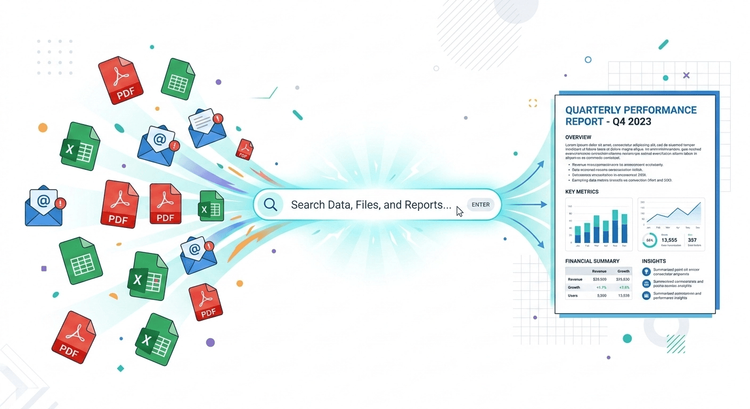
You describe what you want in plain language. Not by clicking through menus or uploading a lengthy style guide. You just tell it what you need. Something like: "Client memo, company header, short summary at the top, financial tables at the back, keep the language simple." Associum builds the template from that, and remembers those rules every time you use it again.
You connect your data room. Associum syncs directly with your folders, so your data, notes, and research are already there when you need them. No uploading, no organising, no copying files across.
The output looks the same every time. Not almost right. Actually consistent. Same fonts, same table styles, same structure throughout. The kind of consistency that usually takes a very careful person to maintain.
You make changes by asking for them. Instead of scrolling through a 40-page document to find one section, you just say "make the risk section shorter" or "match the format from last quarter." The document updates. You check it. You move on.
From raw material to finished report: minutes, not hours.
---
What It Actually Feels Like
The time savings are real. But the bigger change is one that is harder to measure.
It is not just "I saved a few hours." It is more like getting back the part of your day where you felt like you were actually doing your job. The part that needs your judgment and expertise, not just your ability to sit with a frustrating document until it looks right.
It shows up in small ways. Leaving the office at a reasonable hour because the report is already done. Not feeling a quiet dread when a client asks for an updated version of something. Spending the last hour of your afternoon thinking through the actual analysis instead of checking whether the page numbers are aligned. These do not sound like big things. But they add up to a working day that feels meaningfully different.
---
The Bigger Point
Here is something nobody says out loud: report formatting was never supposed to be your job.
It became your job gradually, out of necessity. Templates were set up by whoever had a spare afternoon. Rules about fonts and layouts were enforced by whoever cared enough to bother. Junior staff formatted because they were new. Senior people formatted because they wanted it done properly. Everyone did it because the alternative was sending out something that did not look as good as the work behind it deserved.
This was always the wrong arrangement. The people doing the most complex analysis, giving the most valuable advice, managing the most important client relationships, those are exactly the people who should not be spending their evenings adjusting margins.
The reason it carried on for so long was not that anyone thought it was a good use of time. It was that there was no real alternative. The tools were not capable enough. Automation took too long to set up. The results were never quite right.
That has changed. The tools now exist to make "I formatted this myself" sound as strange as "I did all the calculations by hand."
Your expertise is in understanding what the numbers mean, what the client needs, what the right call is. That is what you were hired for. That is what you are good at. Every hour spent fixing fonts and chasing margins is an hour taken from work that actually requires you.
Report formatting was never your job. You just ended up doing it anyway.
That ends now.
---
Associum is an AI associate built for professionals in finance, consulting, and compliance. Try it at associum.ai.