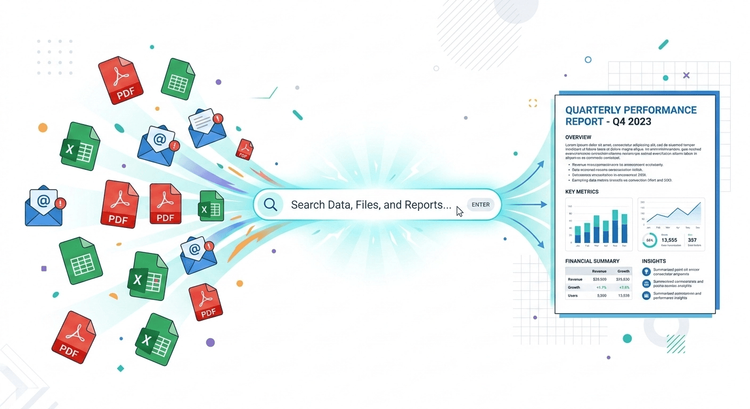
Your Work Generates More Data Every Year. Associum searches all of it.

The Problem Compounds
Think about everything you've worked on in the last three years.
Research reports. Client presentations. Financial models. Contracts. Due diligence files. Industry analyses. Meeting notes. Regulatory documents. Every project adds to the pile. Every new client brings a new data room. Every year in your profession means more institutional knowledge sitting somewhere in a folder, or worse, scattered across folders, inboxes, and drives.
The information doesn't go away. It compounds.
And yet most tools you use to search through it were designed for a world where you had a handful of documents, not hundreds. They work fine at the start. But the moment your volume grows, the moment you actually need to find something across a large, complex, real-world body of work, they quietly stop keeping up.
This is the problem Associum is built around. Not just helping you work with a few documents more efficiently. Helping you work with *all of it*, no matter how much there is, no matter how long you've been accumulating it.
Why Search Fails When You Need It Most
Most professionals have experienced this: you know a document exists somewhere. You remember working on it. You type something into a search bar and get back either nothing useful or ten vaguely related results that require manual sifting.
That's because traditional search, even in most modern AI tools, treats your query in isolation. It doesn't know what project you're working on. It doesn't know who the key players are, what themes matter, or what you've been building toward. It just matches your words against a pile of text and hopes for the best.
The result is that search fails hardest exactly when the stakes are highest. When you're working on a complex deal, a high-pressure engagement, or a research-intensive project with a real deadline. That's when you have the most files, the most complexity, and the least time to hunt manually.
How Associum Searches
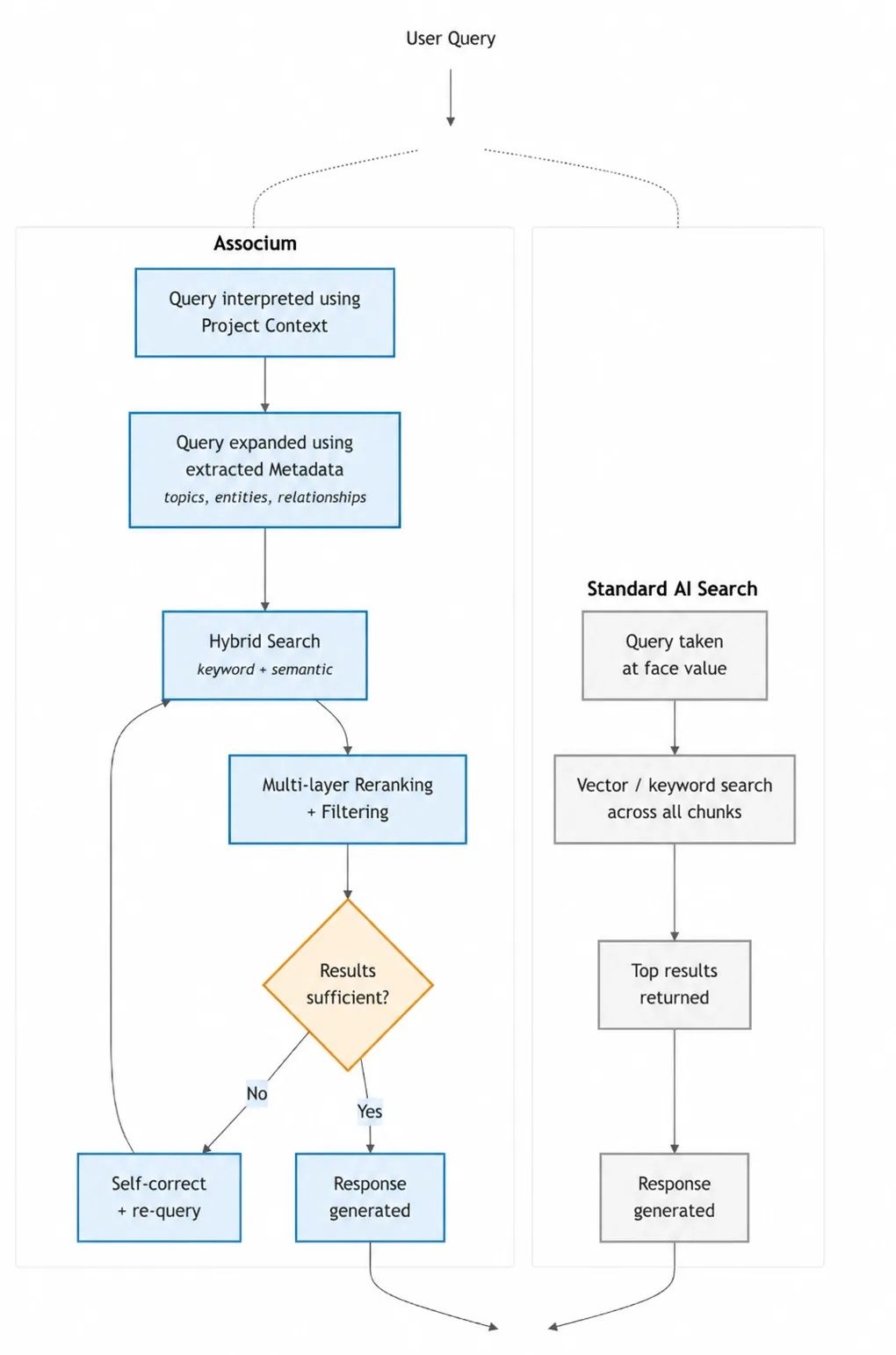
Associum approaches search the way a sharp analyst would: with context, not just keywords. Here's what's actually happening when you ask it a question.
It starts by understanding your documents, not just storing them.
When you add files to a project, Associum doesn't simply index the text. It reads each document to extract what actually matters: the key topics, the entities (companies, people, figures, dates), and the relationships between them. It builds a living understanding of your project, what it's about, what's in it, and how the pieces connect.
This means that by the time you ask a question, Associum already knows the terrain.
****
It uses your project context to form the right query.
Most tools take your words at face value. Associum takes your question and interprets it through the lens of what your project actually contains. If you ask about "revenue risk" in a project full of SaaS contracts and financial statements, it knows what that question really means in your specific context and forms its search accordingly. It then expands the query using the metadata it has already extracted, pulling in related entities, topics, and themes that a simple keyword search would never reach.
It searches smarter, not just faster.
Associum uses a hybrid search approach that combines traditional keyword matching with semantic understanding to cast a wide net without sacrificing precision. It then runs the results through multiple layers of filtering and reranking, including an LLM-based reranker that evaluates whether a retrieved passage actually answers your question, not just whether it superficially resembles it. Irrelevant results are filtered out before they ever reach you.
It knows when it hasn't found enough, and goes back.
This is where most tools stop. They return whatever they found and leave you to judge whether it's complete. Associum doesn't. If the system determines that the results are insufficient or that the search may have missed something, it self-corrects, reformulating the query, adjusting its approach, or pulling additional results before generating a response. You get an answer only when the system is confident it has found the right information.
What This Looks Like in Practice
Say you're a consultant who has just received a full client data room: 500 documents covering financials, contracts, board presentations, and market research going back three years. You have 90 minutes before an internal call and one question to answer. What are the biggest risks to this company's revenue concentration?
In a standard tool, you'd have to curate which files to upload, hope the relevant sections fall within what the system can handle, and accept a response built on a fraction of the available information.
In Associum, you upload the full data room and ask your question.
Because Associum has already built a rich understanding of the project, the entities, the financial themes, the key relationships, it knows exactly where to look. It routes toward the financial statements, customer contracts, and board presentations. It expands the query to pick up related concepts like customer concentration, renewal timelines, and dependency risk. It retrieves the right passages, ranks them for relevance, and filters out the noise. Then it cross-references across documents, connecting the fact that a single customer accounts for 38% of revenue, that their contract expires in eight months, and that the board flagged this exact risk in a presentation two years ago.
You get a sourced, structured answer in seconds. Not because the system searched harder, but because it searched smarter, with full awareness of your project from the start.
This is where most tools stop. They return whatever they found and leave you to judge whether it's complete. Associum doesn't. If the system determines that the results are insufficient or that the search may have missed something, it self-corrects, reformulating the query, adjusting its approach, or pulling additional results before generating a response. You get an answer only when the system is confident it has found the right information.
More Data, Not Less Clarity
Most professionals have learned to manage document volume by managing *less of it*. Archiving old files, manually curating what gets shared with AI tools, deciding what's worth including before every session. That's a workaround for a tool problem, not a real solution.
Your accumulated work is one of the most valuable assets you have. Years of research, analyses, precedents, and institutional knowledge sitting in documents you've built over a career. The ideal isn't to pare that down. The ideal is to search across all of it, instantly, and actually trust what comes back.
That's what Associum is designed to do. Search that understands your project before you even ask. Search that holds up under the full weight of how professionals actually work, where the information never stops growing and the questions never get simpler.
--
Associum is an AI associate built for professionals in finance, consulting, and compliance. Try it at associum.ai.