Deployment and Depth: The Two Problems Enterprise AI Has to Solve
Most organisations that deployed Microsoft Copilot solved a real and difficult problem. They got AI into the hands of every employee, inside the tools IT already manages, through a procurement process the finance team already understood, without setting off the compliance function. When leadership asked whether the firm was using AI, the answer was yes, at scale, safely, and defensibly.
That is not a small achievement. Getting any technology adopted across an entire organisation is harder than getting it to work in a demo. Copilot solved the deployment problem, and for most firms it was the correct first move.
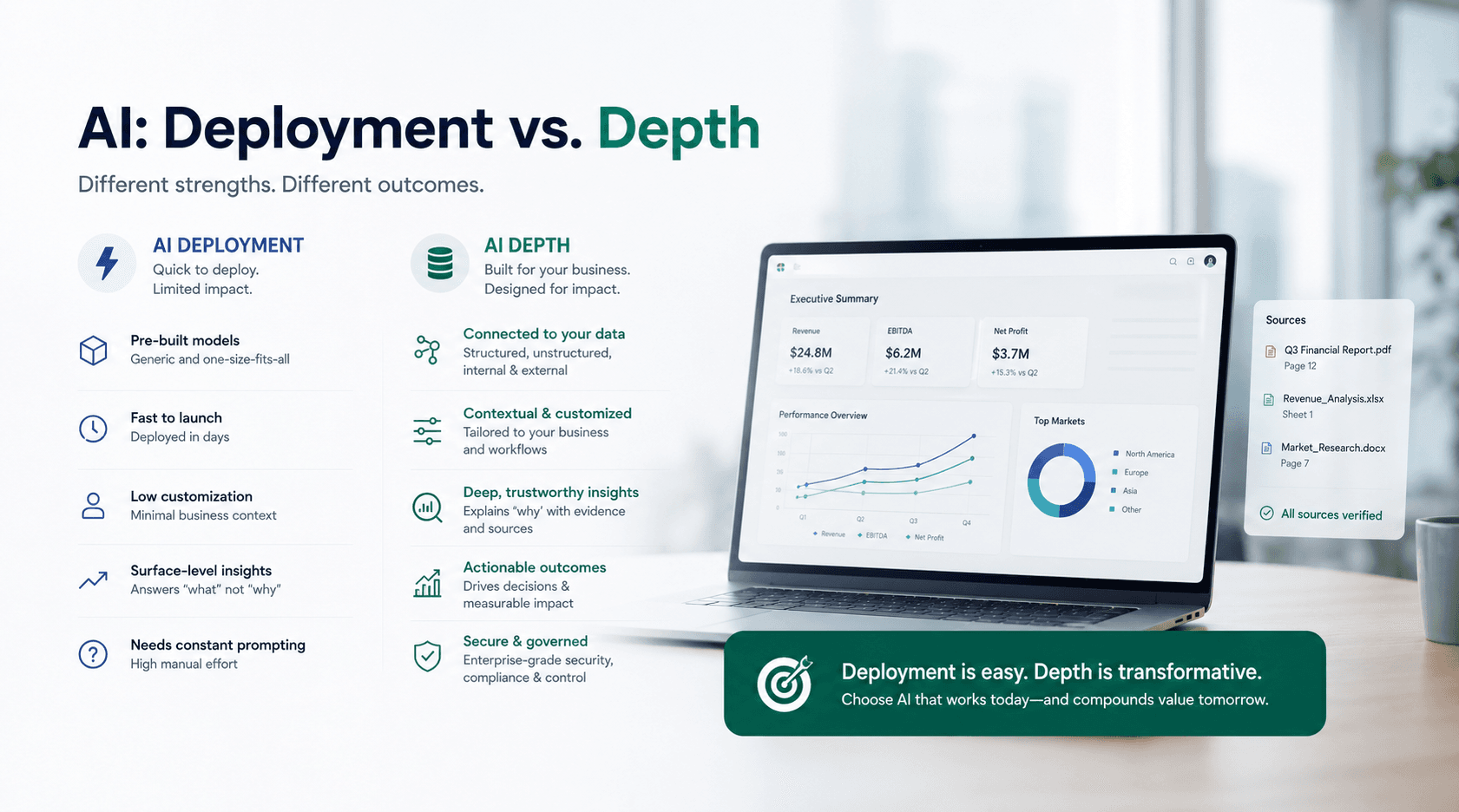
But deployment is only the first of two problems. The second one is depth.
Two different jobs
Enterprise AI has to do two distinct things, and they pull in opposite directions.
The first job is horizontal reach: put a capable assistant next to every employee, in every application, and make everyday work a little faster. Draft the email, summarise the meeting, tidy the slide. This work benefits from being embedded everywhere and touching everything lightly.
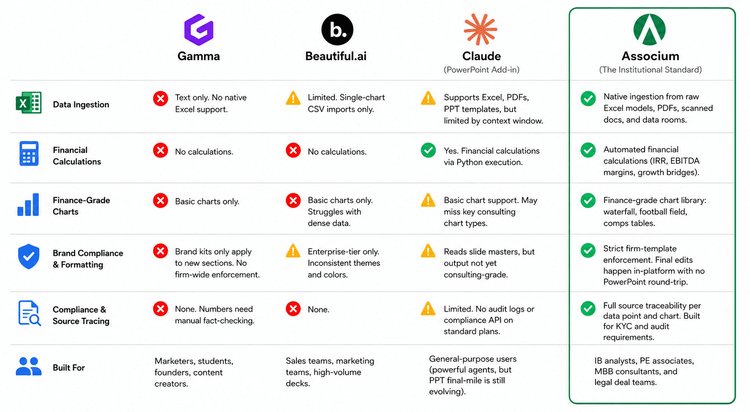
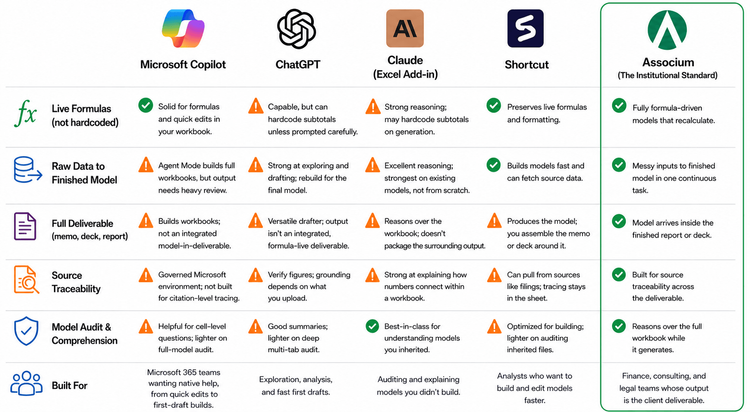
The second job is analytical depth: take the documents that actually carry the value — the data room, the model, the contract stack, the research set — and do the hard work of turning them into a finished deliverable. This work benefits from the opposite design. It needs to ingest large external document collections, reason across them, and produce a client-ready output with clear sourcing.
Copilot was architected for the first job. It lives inside Microsoft 365, searches your mail, calendars, and Teams, and makes the horizontal layer smoother. It was never built to be the second thing, and it is worth being precise about why that matters rather than treating it as a shortcoming.
Why safe was the right answer to deployment
There used to be a saying in enterprise technology: no one ever got fired for buying IBM. It was never a claim that IBM was the best available option. It was a claim that IBM was the *defensible* one — the choice you could stand behind in a board meeting, with institutional legitimacy and a failure mode you could explain.
For the deployment problem, that instinct is exactly right. When the goal is to roll AI out to thousands of people without breaking governance, safe and defensible is the correct specification, and Copilot fits it well.
The IBM instinct only becomes a liability when it is applied to a problem it was never meant to solve. Defensibility gets AI adopted. It does not, on its own, get the analytical work done.
What depth looks like in practice
The firms pulling ahead are not the ones who bought a better assistant. They are the ones who recognised that depth is a separate job and put a separate tool against it.
In those environments, an analyst uploads a full data room and gets a structured diligence summary with sourcing in hours rather than days. A consultant assembles a research-intensive deliverable in a single morning. A legal team reviews a large contract set without assigning juniors to read line by line for a week.
The document that once took several days now takes a few hours. Across a team and over a quarter, that difference compounds, not into minutes saved per person, but into how much high-value work the firm can actually take on, and at what margin.
That is what depth tools are for: not faster inbox management, but more analytical output at a higher standard, produced with sourcing that stands up in front of a client.
The question worth asking
If your AI strategy today is built entirely on a tool that works inside the Microsoft file environment, caps analytical work on its most advanced agents, and struggles with the large external document sets that define professional work, the question is not whether that tool is good enough. For deployment, it plainly is.
The question is which problem you are solving next.
Deployment was step one, and most firms got it right. Depth is step two, and it is a different job that needs a different architecture. The competitive gap opening up in finance, consulting, and legal is not between firms that bought well and firms that bought badly. It is between firms that treated AI as one problem and firms that recognised it as two.
The horizontal layer keeps everyone a little faster. The depth layer changes what the firm is capable of delivering. You want both, and the second one is where the race is actually being run.
--
Associum is an AI associate built for professionals in finance, consulting, and compliance. Try it at associum.ai.