Associum vs. ChatGPT: Why General-Purpose AI Falls Short for High-Stakes Professional Work

Most professionals who use ChatGPT for serious work will tell you the same thing: it is genuinely useful, and it is also genuinely incomplete. The draft comes back fast. The prose is clean. And then you spend the next hour figuring out whether any of it is actually true.
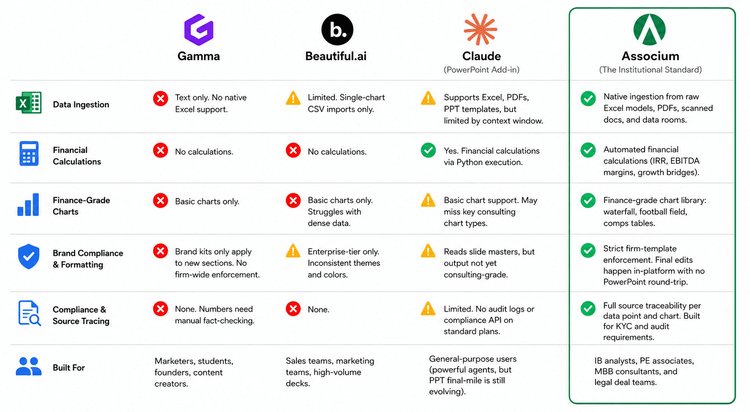
That is the real problem with general-purpose AI in professional contexts. Not that it fails visibly; it rarely does. The problem is that it transfers the hardest part of the work back to you. The verification. The source-checking. The reformatting. The gap between a ChatGPT response and something you can put in front of a client is almost always significant, and closing that gap is still entirely manual.
And that gap widens as the task gets harder. For a simple question or a short draft, ChatGPT is a reasonable starting point. But ask it to synthesize findings across a hundred documents, calculate financial metrics from raw data, ground its analysis in specific source material, and produce something formatted and ready to share, and it stops being a tool that executes the work. It becomes a tool that gestures at the work. The output is a collection of ideas shaped like a deliverable, not a deliverable. What comes next is still entirely on you.
For a consultant billing hours, or an analyst producing a research brief, that gap is where the value of the tool quietly disappears.
---
What ChatGPT Was Built to Do
ChatGPT is a flexible assistant. It can explain complex concepts, help you think through a problem, draft an email in seconds, and generate code that works. For exploration, ideation, and low-stakes drafting, it is one of the most useful tools available.
But it was designed to assist across any domain. Finance, law, and consulting are three of many use cases it handles. It requires the user to supply data, structure the output, and validate every claim independently. That trade-off works when you are learning or brainstorming. It stops working when the output has to go somewhere.
---
The Structural Limitations That Create That Gap
1. No Source Grounding
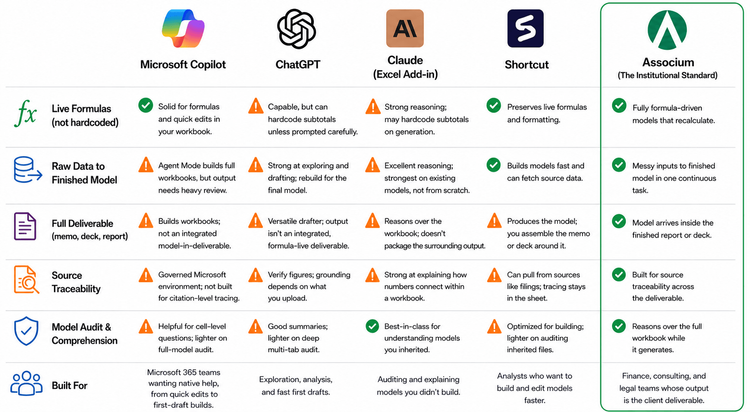
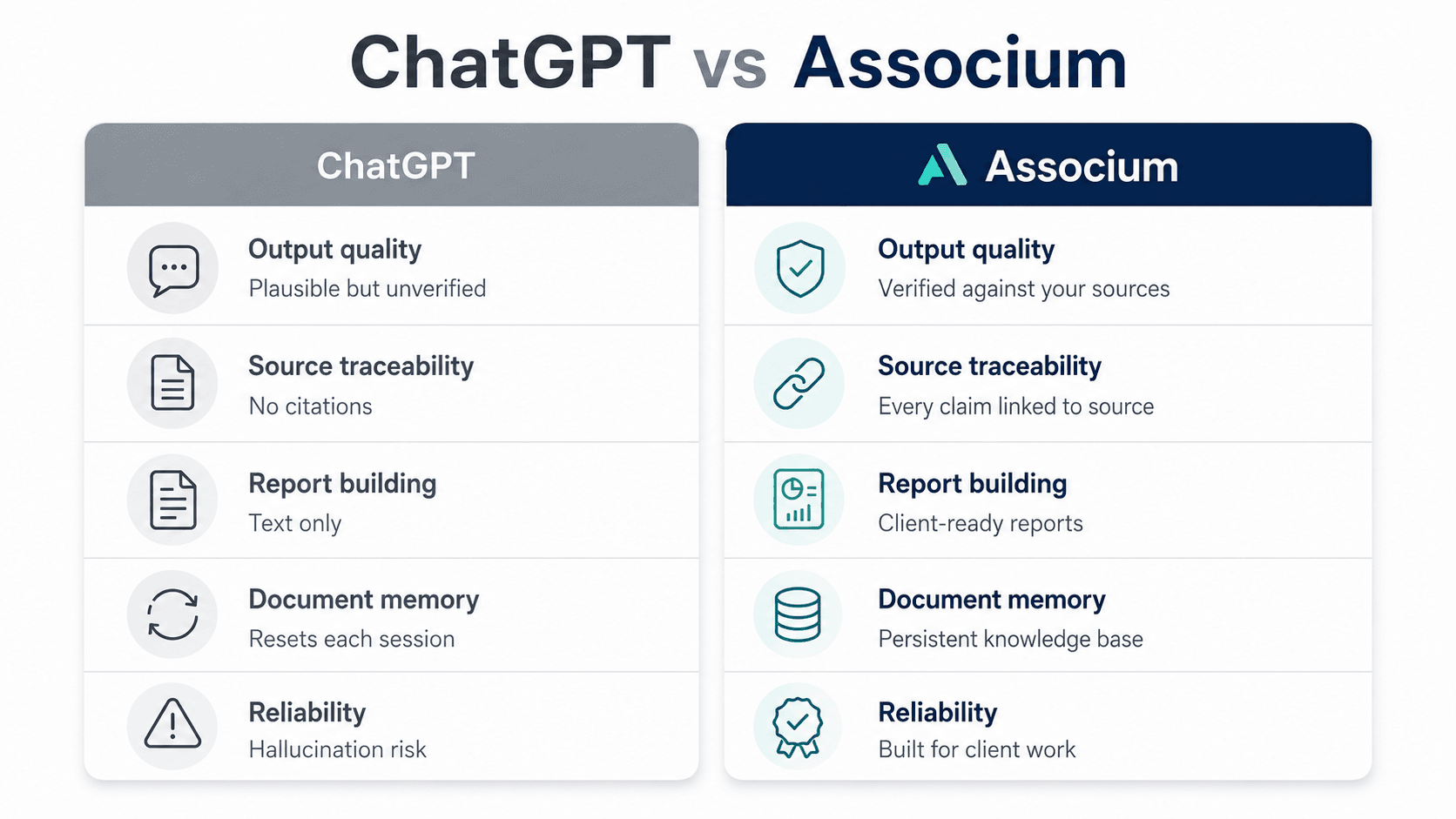
ChatGPT generates responses from patterns learned during training. When it states a statistic, it is producing text that resembles what a cited statistic looks like, not text that traces back to a verifiable origin. The model has no document it is reading from. It is completing a sequence of tokens based on probability.
This means every figure, every claim, every data point in a ChatGPT response requires independent verification before you can use it professionally. That verification burden does not disappear; it just shifts from the tool to you.
2. No Persistent Document Memory
When you upload a file to ChatGPT, it reads within the session. There is no persistent knowledge base. Every conversation starts fresh. If you uploaded a 200-page information memorandum last week, ChatGPT has no recollection of it today. You are always starting from zero, and every analysis is limited to what you can fit in a single upload.
3. No Audit Trail
Professional work requires accountability. If a number appears in a deliverable, someone needs to be able to say where it came from. ChatGPT produces output with no trail, no citations, no source references, no indication of which part of which document informed which sentence. In regulated environments, that is not an inconvenience. It is a disqualifying limitation.
4. Draft Quality, Not Deliverable Quality
ChatGPT generates text. It does not generate finished documents. When you ask it to produce a research brief or an investment summary, you get prose that you then need to verify, format, restructure, and manually move into a Word file or deck. The gap between a ChatGPT response and a document you can share with a client is almost always a meaningful piece of work in itself.
The Same Task, Two Different Outputs
Consider a prompt that reflects real work a finance professional would need to complete:
Prompt: "We are evaluating a mid-market software business. I have uploaded the information memorandum, three years of audited financials, the management presentation, 200 customer interview transcripts from the commercial due diligence, all material contracts the company has entered into, and the relevant regulatory filings for the jurisdictions it operates in. Prepare a two-page deal summary covering business overview, financial performance including revenue CAGR and EBITDA margin trend, key risks across financial, commercial, and regulatory dimensions, and a preliminary valuation view based on comparable multiples in the IM."
What ChatGPT does:
It cannot meaningfully engage with this task as described. The volume of documents alone exceeds what any session-based tool can handle. You would need to decide which documents to upload, which to summarize manually, and which to leave out, which means the analysis is already incomplete before it begins. Whatever output ChatGPT produces will reflect a fraction of the available information, with no way to know what it missed. The figures will need manual verification, the regulatory risks will be generic rather than grounded in the actual filings, and the customer themes will not reflect 200 interviews; they will reflect whatever you were able to paste in. The output will be unformatted prose that still requires significant work to turn into something shareable.
What Associum does:
Associum indexes the entire document set, including the financials, the contracts, the interview transcripts, and the regulatory filings, and retrieves the relevant material for each part of the task as it builds the output. It does not load everything into context at once; it knows where to look. The revenue CAGR and EBITDA margins are calculated from the audited financials with the source figures cited. The commercial risks are drawn from patterns across the customer interviews, not invented. The regulatory exposure is grounded in the actual filings, not general knowledge about the sector. Material contract risks are flagged with references to the specific agreements. The output is structured as a formatted two-page deal summary, ready to share.
The difference at this scale is not marginal. One tool requires you to manually curate what goes in and manually verify what comes out. The other handles the breadth of the task and shows its working throughout.
---
Why "Good Enough" Does Not Exist in This Context
In consumer applications, AI that is right 90% of the time is extraordinary. In professional contexts, AI that is wrong 10% of the time means every output requires a full review pass. The efficiency gain from faster drafting is consumed by the verification overhead it creates.
That is the real calculus for professionals. Not whether ChatGPT can produce impressive-looking content; it can. But whether impressive-looking content that still requires full manual validation actually moves the needle on how they work. For most, the answer after a few months of honest use is: not as much as expected.
The tools that actually change how professionals work are the ones that reduce verification burden, not just drafting time. That requires source grounding, citation traceability, and structured output, not a general-purpose assistant adapted to professional use cases after the fact.
---
The Verdict
ChatGPT is one of the most capable general-purpose tools ever built. Use it to think, to draft, to explore ideas and stress-test arguments before you commit. It is genuinely good at all of that.
But when the work is going to a client, when a partner is signing off, when a counterparty is reading it, when your name is on the document, you need something built for that standard. Not a tool that gets you most of the way there. A tool that gets you to done.
Associum is built for the last mile. The research that needs citations. The memo that needs to hold up under scrutiny. The report that needs to go out tomorrow morning. ChatGPT helps you start. Associum gets you to finished.
--
Associum is an AI associate built for professionals in finance, consulting, and compliance. Try it at associum.ai.