Why Associum Extracts What Other AI Tools Miss
A $200 million CIM lands in your inbox. You upload it to your AI tool and ask for the key financial highlights. The response comes back confident and well-structured: EBITDA margin of 34%, strong revenue trajectory, clean unit economics.
There's just one problem. The actual EBITDA margin in the document was 3.4%. The model didn't fail. It never saw the real number in the first place.
This is the core risk most AI tools quietly ignore, and it starts long before the model generates a single response.
---
The Step Nobody Talks About
When you upload a document to an AI tool, most people assume it "reads" the page the way a human would, seeing its layout and drawing meaning from its contents.
What actually happens is more fragile. Most tools convert the document into raw text and feed that text to the model. If the conversion works cleanly, the AI has good material to work with. If it doesn't, if the parser scrambles a table into a wall of numbers or skips a scanned section entirely, the model has no way of knowing. It works with whatever it received, filling gaps with plausible-sounding guesses.
If you have used any major AI assistant on a scanned CIM or a photographed financial model, you have experienced this. The output sounds authoritative. But the data behind it was never actually extracted from the document.
---
Why Most Tools Break on Real-World Documents
Standard parsing tools were built for clean, digital documents: well-formatted Word files, exported PDFs with embedded text, spreadsheets with tidy column headers. They work reasonably well in those conditions.
Real-world professional documents are different. A CIM that has passed through three hands before landing in your inbox. A due diligence report that started as a printed checklist and was scanned back into a PDF. A financial model where key assumptions live inside a photographed whiteboard slide. A research note with complex tables that no standard converter can reproduce accurately.
In these cases, most tools hit the same failure modes.
Scanned documents with no embedded text layer return blank or corrupted output. The parser simply has nothing to grab.
Complex tables, especially those with merged cells, multi-row headers, or nested structures, collapse into flat strings of numbers and labels that lose all their relational meaning.
Embedded images containing data are skipped entirely. Charts, infographics, and photographed tables are treated as decorative rather than informational.
The AI on the other end does not know any of this happened. It reasons over broken input and produces a polished response.
---
How Associum Gets the Full Picture
Associum was built for professionals who work with documents that are almost never clean, and where the cost of a misread figure is real. That shaped how the extraction layer was designed from the start.
Rather than relying on a single conversion method, Associum combines traditional parsing with OCR to handle the full range of documents professionals actually encounter. Content that returns blank or garbled in other tools, such as scanned pages, image-based PDFs, and photographed tables, comes back structured and accurate.
What this means in practice:
Scanned and image-based documents are fully recovered. Pages that return empty in standard parsers are processed visually, so the content actually reaches the AI layer.
Tables keep their structure. Row and column relationships, header hierarchies, and cell-level formatting stay intact, so a five-year revenue projection remains a table, not a jumbled string of numbers.
Embedded images containing data are processed for the figures inside them, not skipped over. A chart or photographed spreadsheet is treated as content, not decoration.
No single technique handles all of this well. Traditional parsing is fast and precise on clean documents. OCR recovers content from everything else. Together, they ensure that by the time your document reaches the AI reasoning layer, it is complete, structured, and faithful to the source.
---
The Same Document, Two Realities
Consider a scanned investment memo with a five-year revenue projection table and a footnote flagging a key assumption about Southeast Asian market expansion.
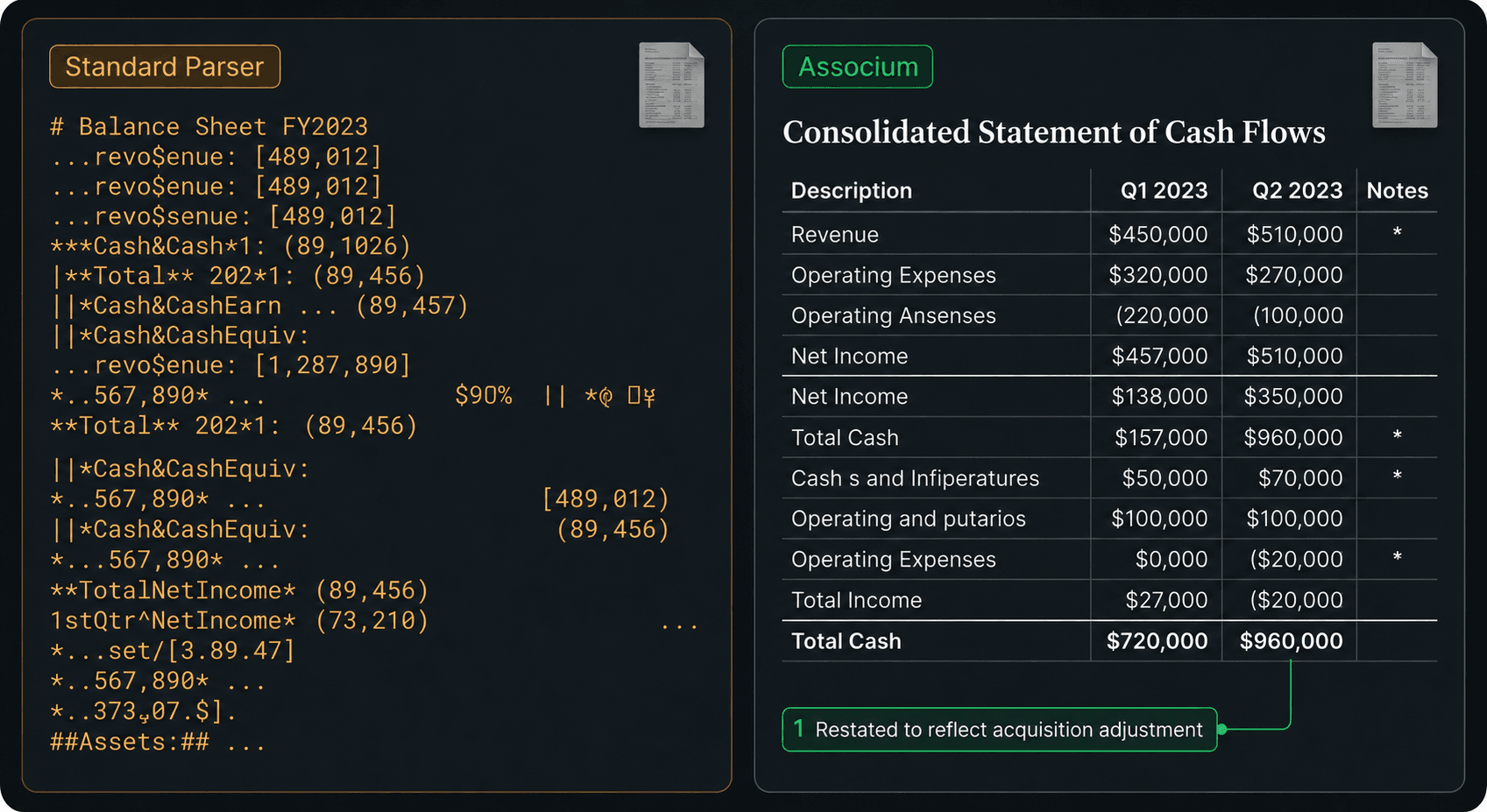
A standard parser returns something like this:
Revenue 2021 142 2022 167 2023 204 2024 231 2025 est 260 note assumes continued expansion SE Asia market see footnote 3
The numbers are there, barely, but the structure is gone. The footnote has been partially recovered but attached to nothing meaningful. An AI reading this cannot reliably tell which figure belongs to which year, or that the caveat applies specifically to the 2025 projection. Any analysis built on this input is a guess dressed up as insight.
With Associum, the same document comes back as a clean, structured object: a properly formatted table with years as columns and revenue as rows, and the footnote captured and linked to the 2025 figure. The AI now has the full picture, and the analysis it produces reflects what was actually in the document, not a reconstruction of it.
---
Input Quality Is Output Quality
When an AI tool gives you a wrong answer from a complex document, the instinct is to blame the model. Usually, the model never saw the real document in the first place. It reasoned carefully over broken input and produced something that sounded right. That is not an intelligence failure. It is an extraction failure.
Associum fixes this at the source. By combining traditional parsing with OCR, it ensures that complex, messy, real-world documents are converted into clean and structured data before any AI reasoning happens. The intelligence you get on the other end reflects reality, not a plausible approximation of it.
For professionals whose decisions depend on what is actually in a document, that distinction is the whole point.
--
Associum is an AI associate built for professionals in finance, consulting, and compliance. Try it at associum.ai.